Controversial as it may, if you're goal is to find the truth of the topics shown here, then I suggest you watch these and other videos. These crimes on the people should be unmasked, and these will continue until the American people wake up and put a stop to the evil perpetrators. The first step is to understand and have an open mind, unbelievable and ugly as it may, that this could really be happening...AMOR PATRIAE
Thursday, March 3, 2022
From intelligence-gathering to training civilians in guerrilla tactics, here’s what the U.S. and NATO might do to push back against the Russian invasion while avoiding escalation.
Biden has already declared that neither U.S. nor NATO military forces will be deployed to the conflict sparked by Russian forces pouring across Ukraine’s borders. The dangers of escalation are simply too great, especially given the threats that volatile Russian President Vladimir Putin has made regarding the use of nuclear weapons. Direct involvement, the thinking goes, is just too risky.
But that doesn’t mean the U.S. won’t be indirectly involved. From gathering intelligence on the ground to training potential civilian partisans in guerrilla warfare, it’s extremely likely the U.S. and NATO will seek to influence events on the battlefield. Here’s how that might work.
According to former U.S. Army Ranger Tom Amenta, there are advantages to having on-site, operational intelligence gathering in Ukraine that can’t be equaled by remote technologies like satellite imagery or radio signal interceptions.
A Ukrainian serviceman gives a thumb up before an attack in Lugansk region on Feb. 26, 2022, the day Russia ordered its troops to advance in Ukraine “from all directions.”
“The value of boots on the ground [in intelligence] is that you get a ‘finger tip feel’ of what is going on,” said Amenta, co-author of the book The Twenty-Year War, in an interview with The Daily Beast. Such intel gives U.S. military observers “a feel of the people and of the battle space and allows for the ability to gauge the situation, almost in real time, and see what is going on with the Russians and Ukrainians to assist commanders in planning.”
Amenta’s co-author, Dan Blakely, another former Ranger, agreed that having local operators for sourcing information would be invaluable in the Ukraine conflict.
“Not only do you get the real-time HUMINT (human intelligence) of what the Russians are doing, but you can have a real pulse of the continued capabilities of the Ukraine military [and] learn the weaknesses and capabilities of our enemies,” including “what weapons, vehicles, aircraft, tactics, and troop units they are using.”
Blakely added that such intel was vital for developing “future strategic plans should the U.S. and NATO allies get involved.”
When it comes to gathering HUMINT, one option for elite U.S. forces is the use of Special Operation Groups (SOGs). Amenta described the typical SOG as a small, covert, reconnaissance task force, often made up of intelligence agents from the NSA or CIA, paired with Special Forces soldiers like Green Berets or Delta Force commandos. In order to avoid detection, the SOGs are able to work undercover within local populations.
“They’ve essentially mobilized the entire nation.”
“These men and women are extremely skilled in blending into environments, gathering intelligence and also being able to work with and help guide [and] assist local military forces,” Amenta said.
Because secrecy is of paramount importance, SOGs working in Ukraine would likely be limited to just a few officers in each unit. But Amenta framed it as an issue of quality over quantity, saying that the “training, raw intelligence, and ability to rapidly ideate and think strategically is what wins the day here.”
But not everyone is in favor of using SOGs in Ukraine.
Dr. Robert J. Bunker, the research director at the security consultancy ℅ Futures LLC, said the risk that an SOG team or a NATO equivalent could be killed or captured, and linked back to their countries of origin, means that the risk far outweighs the reward.
Putting U.S. intelligence gatherers on the ground in any capacity is just not a “viable option,” Bunker said. “In my opinion it is too escalatory given the fact that both the Putin regime and the U.S. are nuclear armed powers… We simply do not want NATO or U.S. forces and Russian forces getting into direct contact with one another.”
Lieutenant Colonel (retired) Hal Kempfer, who served as a U.S. Marine Corps Intelligence Officer, said that it’s “very possible” that the U.S. has spies on the ground in Ukraine. But Kempfer also said a safer option to avoid escalation would be to utilize Ukrainian nationals to gather vital HUMINT information and pass it on to their counterparts in the U.S. and NATO.
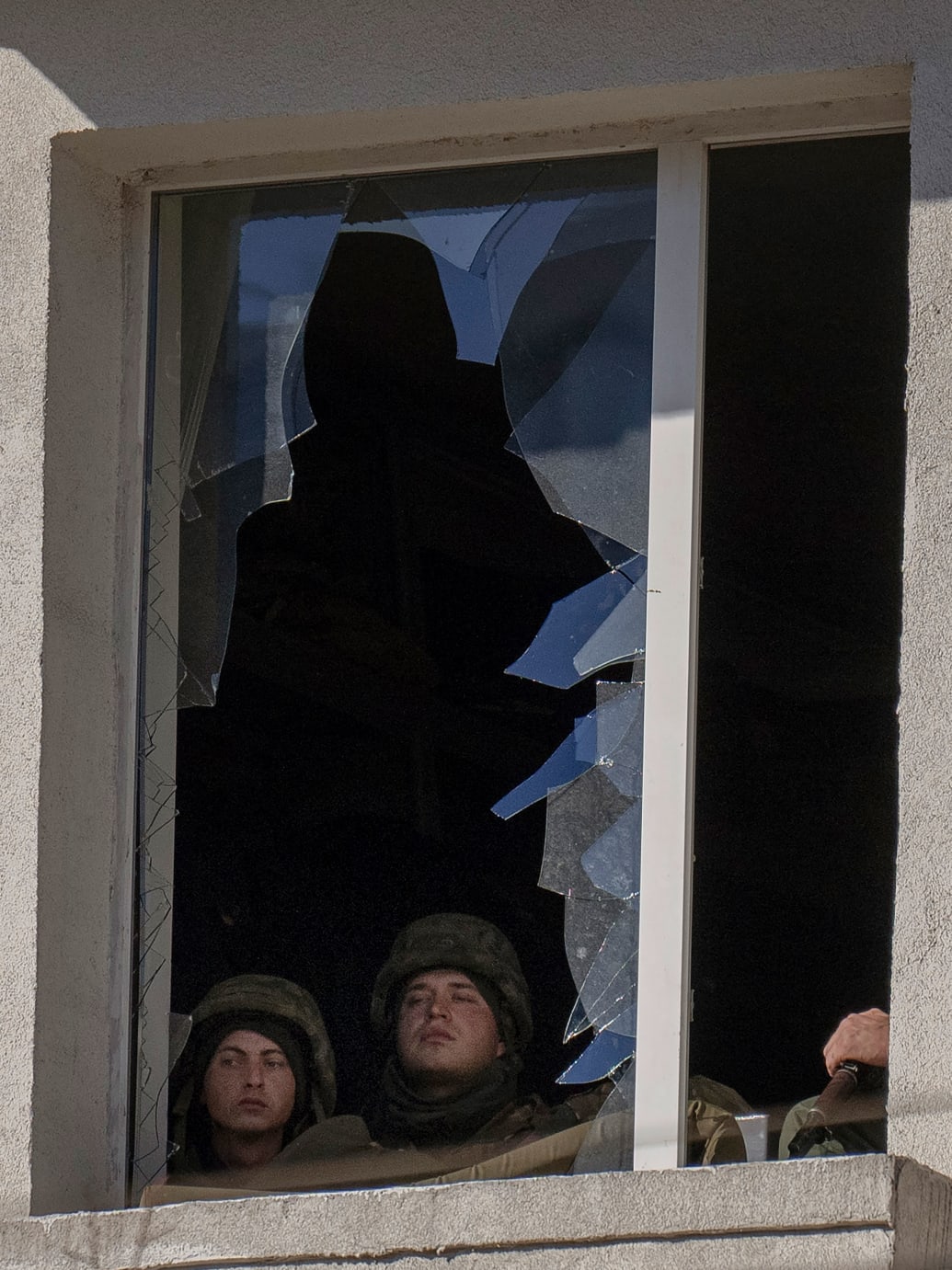
Ukrainian soldiers look out from a broken window inside a military facility, after an explosion in Kyiv, Ukraine, Feb. 26, 2022.
Emilio Morenatti
“We don’t really need to have [U.S. or NATO spies on the ground] because we can deal directly with Ukraine forces, many of whom we’ve trained, and trained to a standard where they can provide tremendous intelligence capability,” Kempfer said.
“They’ve essentially mobilized the entire nation. You have federal law enforcement [mobilized]. They’re really good at observing and reporting. And good at avoiding detection while they do that. So a lot of them might be wearing civilian clothes and collecting intelligence,” he added.
Even if U.S. special forces did not enter Ukrainian territory, that does not mean they won’t be playing a vital role. One of their most important functions might well be training Ukrainian soldiers or ordinary citizens in the tactics of guerrilla warfare they would need to resist the occupation of their homeland. Just such tactics were employed by Mujahideen fighters during the Soviet-Afghan war of the late 20th century—tactics that eventually forced the Soviets to withdraw.
On Friday, the BBC reported that at least 18,000 assault rifles had been handed out to the citizens of Kyiv, and the international community is rife with speculation that the conflict could devolve into a prolonged anti-Russian insurgency.
That’s partly because Ukraine is almost the size of Texas, with a population of about 43 million people. About 70 percent of the population is concentrated in urban areas, meaning that: “We could be looking at house-to-house fighting in which tens of thousands of armed defenders face the invading forces,” said research director Bunker.
In the event that the major cities were pacified by the Russian forces, an occupation phase would then begin during which “Ukrainian civilians and the relatives of the insurgent fighters” would be targeted, Bunker said. “Along with the brutality of such an occupation this would begin to strain the Russian economy to logistically support the deployed force.”
Former Ranger Amenta agreed with Bunker that Russian forces could get bogged down in a potential quagmire. “Once you take the territory you are no longer the aggressor. [Then] you are in static positions that restrict your freedom of movement, and you’re an easier target,” Amenta said. “And 200,000 Russian soldiers against 43 million people who don’t like you—that’s a really hard thing to accomplish.”
In the event of a prolonged insurgency that might turn into a war of attrition, the U.S. and NATO would likely see it in their own interests to provide training and munitions to partisan fighters, in similar fashion to what the U.S. did in Europe during the Nazi occupation.
“It’s all fun and games until someone throws a nuke.”
When asked, a senior U.S. defense official told The Daily Beast that the U.S. would not rule out training Ukrainians. “We’re going to continue to look for ways to support the Ukrainian armed forces, and to help them defend their country,” they said.
Former Marine Colonel Kempfer, who cited similar efforts conducted by the U.S. in Iraq and Afghanistan, described training host-nation personnel as “a traditional Army Special Forces mission.” Amenta agreed, calling such training the Special Forces’ “bread and butter.”
“They’d be teaching [Ukrainian partisans] how to use things like Stinger anti-air missiles and javelin anti-tank weapons to slow down Russian tanks and helicopters. They’ll also teach ambush and guerrilla warfare techniques, especially things that can destabilize or slow down the Russian movement, and, if they were attempting to hold territory, to make it very difficult for them to keep it.”
One major question might be where would such training take place. If U.S. forces are barred from entering an occupied Ukraine, nearby NATO allies like Poland and Romania would seem like potential candidates. American troops arrived in both of those nations this week to help them defend against potential Russian incursions, meaning that the personnel needed for setting up guerrilla warfare schools may already be in place.
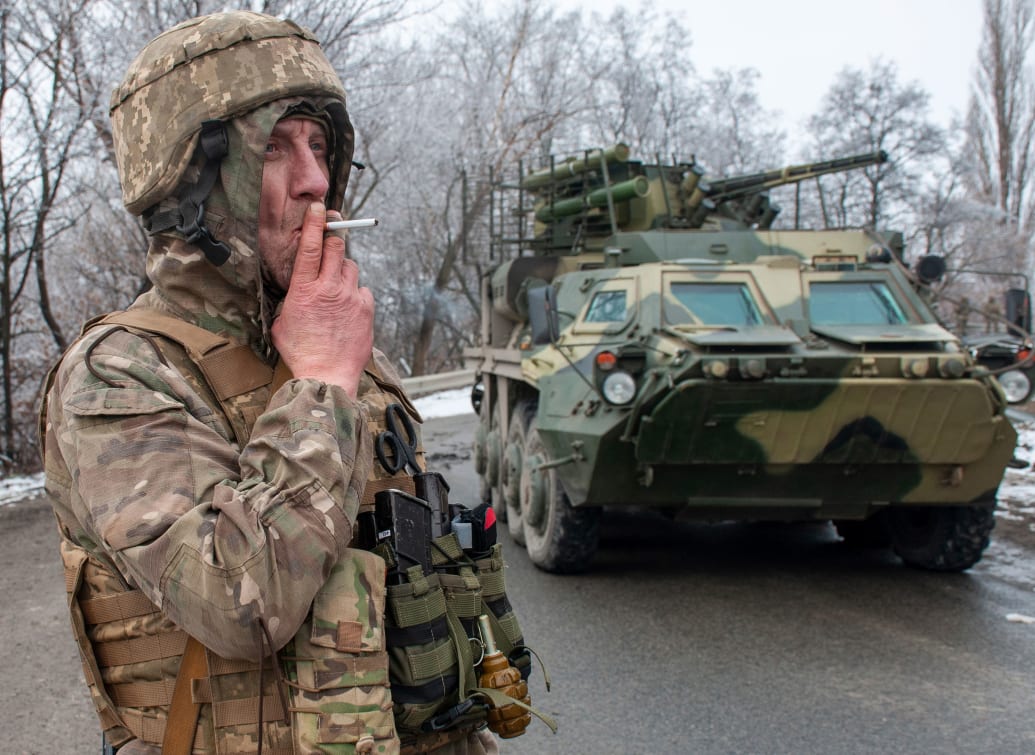
A Ukrainian soldier smokes a cigarette outside Kharkiv, Ukraine, Feb. 26, 2022.
AP Photo/Andrew Marienko
The trouble with basing training camps in NATO countries, said Kempfer, is that the Kremlin might see that as aggressive interference within its sphere of influence.
“If you train partisans in Romania or Poland and then they return to Ukraine [to engage Russian forces]—how would Putin view that? You have to look at the political volatility of that.”
Kempfer also pointed to Putin's KGB background and his penchant for being ruthlessly vindictive against any perceived threat.
“This is someone who used a nerve agent to assassinate dissidents on British soil… My concern would be that if we brought [the partisans] to a NATO country Putin could take some sort of overt military action against that NATO country and that would cause a massive escalation. The other concern is that he would use covert means against that country to destabilize the situation in and around where we’re doing the training. That’s very much in his kit bag.”
Kempfer said that one solution might be the use of virtual or online training. “From an operational risk perspective, that’s the safest thing we can do,” he said.
Kempfer also discussed the possibility that many members of the Ukrainian diaspora in the U.S. and Western Europe might see themselves as beholden to return to their homeland to take up arms.
“I fully believe that’s going to happen,” Kempfer said, and also mentioned that such an influx of voluntary foreign fighters could provoke Putin into unfairly claiming deliberate interference by the U.S. or NATO.
“There’s reality and then there’s whatever Russia wants to say,” Kempfer said. “It’s all fun and games until someone throws a nuke.”
There is a lot of talk in the West about Russian President Vladimir Putin being mentally unhinged. How could he not have known that his invasion of Ukraine would have serious consequences for his country? Or is he so obsessed with maintaining an image of greatness—especially ahead of Russia’s upcoming 2024 presidential elections—that he doesn’t care?
Either way, Putin risks losing the confidence of his people, whose economic suffering will increase as the conflict continues.
Desperate Russians Race to Withdraw Cash as Sanctions Send Currency Into Free-FallPerhaps the question of Putin’s sanity is beside the point, because there is little the West can do about it. Although both Hitler and Stalin were crazy by any psychiatric standard, they were still able to inflict horrific damage and death on millions of people. But Hitler did not have nuclear weapons, and Stalin’s hydrogen bomb was still being tested when he died. Putin’s nuclear arsenal, on the other hand, could destroy parts of the West in minutes.
In a nationally televised address last Thursday, Putin offered a menacing warning of Russia’s nuclear capability: “No matter who tries to stand in our way or all the more so create threats for our country and our people, they must know that Russia will respond immediately, and the consequences will be such as you have never seen in your entire history.” On Sunday, Putin went even further by announcing that Russia’s nuclear forces have been put on high alert, an order that NATO Secretary General Jens Stoltenberg called “dangerous rhetoric” and “irresponsible behavior,” which “adds to the seriousness of the situation.”
The more casualties Russia suffers, the more unpopular the war in Ukraine will become back home.
The only other time that the Kremlin’s nuclear threat reached this height was during the Cuban missile crisis in 1962. But Khrushchev—though volatile and impulsive—was apparently a rational actor, not consumed by the historical grudges and the need to show off his masculine credentials that seem to obsess Putin. Khrushchev also had to consider the views of fellow Politburo members. Although Putin purports to consult with advisers, he seems to make key decisions on his own. Russian Defense Minister Sergei Shoigu and Chief of the General Staff of the Russian Military Valery Gerasimov looked uncomfortable as they sat with Putin when he made Sunday’s announcement, but if they had reservations, they were ignored.
If Putin is indeed so detached from reality in the pursuit of his reckless confrontation with the West, what are his motivations?
First of all, like any dictator, Putin does not feel confident of his hold on power. He knows that he was not democratically elected to the presidency in 2018, or even in 2012, because serious contenders were barred from participating. Using his powerful security services, Putin has suppressed the media and arrested democratic oppositionists, including Alexei Navalny, who has been in jail for over a year after being poisoned. Ultimately, the Russian leader cannot be sure what his people really think of him.
Putin’s approval ratings were around 65 percent at the end of 2021, which may seem impressive by Western standards, but Russians are conditioned to say they approve of their leader when there is no alternative. Adding to that, as Putin knows, the continued decline in incomes and living standards is a potential trigger for serious dissatisfaction with his leadership.
Because of this insecurity, Putin hates having democratic states on his country’s border, especially Ukraine. He doesn’t want his people to get ideas. All Putin’s talk about the West destroying Russian values and NATO threatening Russia with nuclear weapons camouflages his intense fear of democratic aspirations in his own country.
Putin admitted as much on Thursday: “Of course, the question is not about NATO itself. It merely serves as a tool of U.S. foreign policy. The problem is that in territories adjacent to Russia, which I have to note is our historical land, a hostile ‘anti-Russia’ is taking shape.” And later: “Russia cannot feel safe, develop, and exist while facing a permanent threat from the territory of today’s Ukraine.”
Putin is all the more alarmed about NATO support for states along Russia’s border because of his growing concerns over how much longer he is going to stay in power. Although the Russian presidential election is two years away, there is reportedly considerable disquiet in the Kremlin about what will happen in 2024. Putin himself said last October that he would not say what his plans are because “it would make the [political] situation unstable.”
Protesters in cities across Russia have come out to show the Kremlin how little respect they have for this war.
Leadership succession in countries where the autocratic leader and his cronies have amassed great wealth at the expense of their people, as in Russia’s case, is fraught with danger. Once out of power, they could be called to account by the new government, and ensuring that a designated successor will protect their interests can be problematic, especially if members of the elite know one another’s secrets and there is infighting. Accusations of corruption are potent political weapons in Russia.
Putin needs to be in a strong position, with high support from Russians, when he decides what happens in 2024. Either he runs again or his loyal, hand-picked successor does, and he can retire happily to his sumptuous palace in Gelendzhik. He is staking his claim on Russia’s future by invading Ukraine and demonstrating to his patriotic citizenry that he can stand up to NATO.
Putin may have been inspired by memories of the Chechen war, which catapulted him to the presidency in 2000. He was a virtual unknown when Yeltsin appointed him prime minister—and his designated successor—in August 1999. As with Ukraine today, Putin used a false flag as an excuse to invade Chechnya, claiming that Chechen terrorists were responsible for September 1999 bombings in Russia. As a result of his determined pursuit of the ruthless Chechen war, Putin’s approval ratings skyrocketed.
Significantly, in Thursday’s address, Putin mentioned this war and brought up the old, false accusation that the West had actively supported the terrorists there. Putin’s goal in Ukraine is the same as it was in Chechnya—installing a Kremlin-sponsored regime to take the place of one that won’t march to Moscow’s tune. He also hopes that his bold aggression will bring him the affirmation at home that he got with the Chechen war.
But all is not going according to Putin’s plan, with Ukrainian resistance stronger than expected and Western sanctions crippling. This is probably why Putin resorted to the insanity of his nuclear threat.
If Putin seems both narcissistic and deranged to the West, his own people may be getting the same impression, especially now that he has started talking about using nukes. And feelings of patriotism can only go so far when pocketbooks are empty. As political commentator Anton Orekh noted: “The effect of the current patriotic enthusiasm will be even shorter than after the Crimea. The economic situation is getting worse, so after some time even a victory over the Kyiv junta and the Anglo-Saxons will arouse people less than prices in stores and half-empty shelves.”
Unlike those who lived under Stalin and Hitler, Russian people today do not face death if they protest on the street, though they can be thrown into jail, as we have seen with the thousands of arrests in the past few days. Nor would Putin’s subordinates be shot if they refused to go along with Putin’s further acts of aggression. So, hopefully, Russians themselves will take action and stop their leader before “the consequences we have never seen in our entire history” are allowed to occur.
Sunday, January 16, 2022
RUSSIA IS RESURRECTING THE MISSILES OF OCTOBER IN A LARGER SCALE
Challenging events are happening above the surface of our oceans. American, Chinese and even Russian naval vessels seem to be getting in each other’s space and causing occasional headlines. There’s also been an intense standoff in space where these superpowers seem to regularly create space debris in the hopes that it will smash up the other side’s massively expensive military satellites. The US had thought it had a lock on precision targetting of satellites. But, China has recently shown that it can match or better this capability.
Like everything else, military hardware is dramatically improving. The Russians are test-firing hypersonic missiles from their Severodvinsk submarines in The Barents Sea. The Chinese recently tested their new hypersonic missiles too. Officially, these are no longer ICBMs, Intercontinental Ballistic Missiles. They are FOBS, or A Fractional Orbital Bombardment System which involves sending missiles through a partial orbit around the earth to strike targets from an unexpected direction. General Milley, Chairman of the Joint Chiefs, responded to the recent FOB test calling it a “Sputnik moment” for America. China’s hypersonic weapon circumnavigated the whole globe recently for the first time. In response, the American Ambassador to the Conference on Disarmament in Geneva said, “We just don’t know how to defend against that technology, neither does China, neither does Russia.” The point is that we had ten days to save the world when the US and Russia stood on the brink of a nuclear exchange in 1962 during the Cuban Missile Crisis. Today missile systems are so fast, and increasingly automated. Will we even have minutes, let alone days?
Luckily, most nations do not want anything like that to happen. The old warfare was about damaging an opponent’s hardware before it could do any damage. The new warfare is about denial of use. It’s about damaging access to the digital operating space by disrupting access to WIFI, GPS and Sat Nav. But, that has untold consequences for civilian life we should all be thinking about.
Further complicating matters, the Superpowers seem to have spent the last decade pushing militaries themselves off-balance sheet. The debt problem has led to the privatization of militaries. We may have more mercenaries funded by governments today than at any time in history. The Russians have done the same, perhaps for other reasons. Plausible deniability is valuable in a world where conflict is remote and subthreshold. Private American and Russian mercenaries and Chinese "contracters” seem to be all over Africa, the Middle East and Asia these days. It has become nearly impossible to disentangle the role of the state and private military organizations in this new era of competition, confrontation and sub-threshold conflict.
The militaries of the superpowers have re-established strong lines of communication amongst themselves, even if the superpower leaders have not. President Biden is begging for a hotline to Beijing; however, Premier Xi Jinping seems to prefer speaking directly to CINCPAC, the Commander in Chief, US Pacific Fleet. Putin opts to send warnings about not “crossing any red lines” to the US military through the media. Most certainly, what the militaries say to each other, often without words but with weapons, might not translate into understanding amongst the general public.
When nations are nose-to-nose, but the public doesn’t know, the risk is that we get caught by surprise.
Historians will look back and be surprised that we were surprised. Isn’t that always the case?
WWIII may feel benign because it is silent, because it is digital, because it is occurring far away and without civilian involvement. Investors have priced geopolitical risk at zero. Until the public awakens to the true situation, the enormous gap between those who are in the know and those who don’t know is a danger to everyone’s future.
Russia will not drop a demand that NATO “be rolled back” to its 1997 boundaries, according to a senior Russian envoy, a requirement backed by the threat of “a large-scale conflict in Europe” arising out of Ukraine.
“We are not bluffing,” Russian Deputy Foreign Minister Sergei Ryabkov said Monday, per state-run TASS. “These are our real proposals. The West’s awareness of this needs to be facilitated, and we are going to make every effort to achieve it.”
Russian President Vladimir Putin has amassed military forces around Ukrainian borders, ostensibly due to the dangers presented by Ukraine joining NATO at some future date. Putin’s team, which oversaw the annexation of Crimea and the invasion of eastern Ukraine in 2014, portrays the latest round of tensions a consequence of NATO expansion over the last 25 years, raising the prospect of a major war in Europe.
“It is important to lower the degree of confrontation caused by the way our U.S. colleagues are looking after their Ukrainian proteges,” Russian Foreign Minister Sergey Lavrov said in an interview published Sunday. "The course on dragging Kyiv into NATO with the prospect of deploying attack missile systems near our borders creates unacceptable threats to Russia’s security, thus provoking serious military risks for all parties involved, up to a large-scale conflict in Europe.”
Ukrainian President Volodymyr Zelensky wants to join NATO, but that process has been stalled for nearly two decades. President Joe Biden said in July that "it remains to be seen” whether Ukraine ever will “meet [the] criteria” for membership in the trans-Atlantic alliance, but Russian officials want NATO to close the door on the idea.
“We would like to emphasize that the nonexpansion of NATO and preventing the deployment of weapons systems near the Russian border that threaten Russia’s security will be front and center during the upcoming talks with the United States and NATO,” Russian Foreign Affairs Ministry spokeswoman Maria Zakharova said Saturday. “This is something those who until now have been unable to grasp Russia’s position must understand.”
NATO leaders agreed in 2008 that Georgia and Ukraine should have the option at some point of joining the alliance, but Russia has invaded both of those countries in the intervening years, creating territorial disputes that short-circuit using the trans-Atlantic alliance’s collective defense guarantee to avert a conflict.
"Yet the Kremlin has, in effect, exercised ... a veto,” former U.S. Ambassador to Ukraine Steven Pifer wrote in October. “Allies appear unenthusiastic ... because there is no good answer to the question ‘if Ukraine joins NATO tomorrow, does the alliance then find itself at war with Russia?’”
Putin has sought to pose that question even in the absence of any serious progress toward Ukrainian membership in NATO.
“We demand an official withdrawal of the decision made at the 2008 Bucharest summit relating to Ukraine and Georgia’s [intentions] to join NATO,” Ryabkvo said. “When we say that further expansion of NATO needs to be prevented, when we say that NATO facilities and all kinds of activities that are provocative for Russia need to be rolled back to the positions that existed in 1997 when the NATO-Russia Founding Act was signed, we are not bluffing.”
Russia warns of potential ‘large-scale conflict in Europe’
Russia's top diplomat believes that US-NATO missiles near the Russian border would increase tension and worsen the risk of escalation.
Ukraine’s possible accession to NATO poses “unacceptable threats” to Moscow, including the possibility that missile defense systems could be placed directly on the Russian border, the country’s foreign minister said on Friday.
“The policy of dragging Kiev into NATO with the prospect of missile strike systems appearing near our borders poses unacceptable threats to Russian security, provoking serious military risks for all parties involved, up to and including large-scale conflict in Europe,” he said.
Lavrov’s comments to the Bosnian outlet come as relations between Russia and the US-led military bloc remain at a crisis point.
The recent uptick in tensions follows reports that Moscow is massing troops on the Ukrainian border, with some Western media outlets suggesting an invasion is around the corner. NATO has repeatedly warned Russia that it is preparing a set of sanctions that would be imposed if any military action is taken.
Earlier this week, at an expanded meeting of the Ministry of Defense, Russian President Vladimir Putin explained that, if NATO infrastructure appeared in Ukraine, it would only take 7-10 minutes for a missile to reach Moscow, stressing that this was “a serious challenge for Russia.”
Last Friday, Moscow pitched a list of proposals to the US and NATO in the form of two draft treaties. The documents consist of a list of security guarantees, including a demand that NATO won’t expand eastwards into states that were formerly a part of the USSR. If signed, it would also see troop movements near the Russian border be limited and prevent missiles from being placed near the frontier.
Thursday, December 30, 2021
A NEW YEAR AND A SAD YEAR IF EVER THE PHILIPPINES IS A COLONY AGAIN
How the Philippines is turning into a Chinese colony. What is the Philippines up to? I’m serious! What on earth is going on in this country? Has it surrendered to China completely? Manila is really prostrating before China in the final months of Rodrigo Duterte’s presidency like no other country ever has, apart from China’s client state — Pakistan. Which brings us to an even more important concern. Is China turning the Philippines into its latest client state? The indications are all out there. The Philippines is being systematically turned into a Chinese colony, and as Duterte prepares to leave office in the next few months, the danger to this southeast Asian country is at an all-time high. As Duterte approaches the end of his term as president, he really has nothing to lose and nothing to fear. So, he is paving the way for China to colonise the Philippines. The Philippines had a telecom sector not long ago ridden with a duopoly. And how do you think the government tried and increased competition in the country’s telecom sector? By roping in a Chinese state-owned telecom company to acquire 40% stake in a major Filipino network provider! China’s gradual takeover of the Philippines. The Philippines’ China Telecom-backed mobile challenger has started to gain ground. According to Nikkei Asia, Dito Telecommunity’s local owner, DITO CME Holdings, kicked off an 8 billion-peso ($160 million) stock rights offering. Dito this month hit 5 million subscribers. According to chief administrative officer Adel Tamano, revenue reached 2 billion pesos. Dito’s subscriber market share stands at 3.1%, which is slightly higher than the 2.9% share which its rival, Sun Cellular clocked in 2003 — its first year of operation. But here comes the interesting part. Dito is 60% controlled by the group of Dennis Uy, a business owner and campaign donor to President Rodrigo Duterte, while state-backed China Telecom owns 40%. Essentially. Duterte and the CCP are in bed together, and they don’t really seem to care about what the public thinks of them any longer. But here’s what’s most shocking about China’s colonisation of the Philippines — It is legally mandated! That’s right. According to the commitments which Dito made in its 2018 telecom license auction, the Chinese-controlled company is required to cover at least 70% of the country’s roughly 110 million people in 2022. In line with the same, the telecom provider plans to take its presence from 500 municipalities and cities which it currently caters to, to 800. Therefore, Rodrigo Duterte paved the way for Dito’s rise as a formidable player in the telecom sector of the Philippines in 2018 itself.
IGNORANT FILIPINO ELECTORATE VOICE SUPPORT TO A MANCHURIAN CANDIDATE THE SON OF FORMER DICTATOR MARCOS
The son of late Philippine dictator Ferdinand Marcos has emerged as the clear favourite for next year's presidential election, taking more than a 20-point lead over his closest rival in a poll published on Wednesday.
Ferdinand Marcos Jr topped the Pulse Asia Survey of 2,400 respondents with 53% of votes, while his running mate, Sara Duterte-Carpio, the daughter of President Rodrigo Duterte, topped a separate poll for vice president with 45%.
Respondents to the Dec. 1-6 poll were asked to pick their first choice for president and vice president if the vote were held during the survey period. In the Philippines, the president and vice president are elected separately.
The election to choose a successor to Duterte, who is barred by the constitution from seeking re-election, is on May 9.
The Marcos family is among the country's most famous dynasties and despite its fall from grace, it has retained powerful political connections and steadfast support in its stronghold of Ilocos Norte province.
Working to the advantage of Marcos, analysts say, is his strong social media presence aimed at the youth, who make up half of eligible voters who were not born when Marcos senior was in power.
Marcos' closest rival for president, Leni Robredo, the current vice president, trailed at 20%, with Manila city mayor Francisco Domagoso and former boxing champion Manny Pacquiao, both getting 8% each.
Marcos' level support in the poll was a record for a presidential candidate since Pulse Asia started polling. Before Marcos, the record was held by Benigno Aquino III, who got 45% in a December 2009 survey, and eventually won the 2010 presidential contest.
But an early lead in opinion polls does not guarantee a win, said political analyst Ramon Casiple, as he recalled how Duterte, a late entry into the 2016 presidential race, only started topping surveys a month before the May election.
Several groups have sought to bar Marcos from the presidential race because of a three-decade Felony conviction on tax evation and a sentence of a year in jail, but a corrupt Comelec decided to break the law on the eligibility of felons for candidacy to proceed.
Individuals that have committed felony crimes can have their civil rights restored by completing all aspects of their sentences, including probation. They must not have any active criminal charges and have to have paid all restitution, which Marcos Jr. did not fulfill.
They can seek to re-establish their rights through the process of clemency, given that they have met the criteria. Giving mercy through clemency does not establish innocence but does allow for a felons’ rights to be restored, thus allowing them to hold public office.
Oddly enough, the loss of civil rights only affects the ability to hold public office but does not affect an individual’s right to run for office. There have been occasions that a felon has run for and was elected. In these cases, they were disappointed to discover that they would not be allowed to take office because of the law.
Thursday, December 23, 2021
IGNORANT FILIPINO ELECTORATE VOICE SUPPORT TO A MANCHURIAN CANDIDATE THE SON OF FORMER DICTATOR MARCOS
The son of late Philippine dictator Ferdinand Marcos has emerged as the clear favourite for next year's presidential election, taking more than a 20-point lead over his closest rival in a poll published on Wednesday.
Ferdinand Marcos Jr topped the Pulse Asia Survey of 2,400 respondents with 53% of votes, while his running mate, Sara Duterte-Carpio, the daughter of President Rodrigo Duterte, topped a separate poll for vice president with 45%.
Respondents to the Dec. 1-6 poll were asked to pick their first choice for president and vice president if the vote were held during the survey period. In the Philippines, the president and vice president are elected separately.
The election to choose a successor to Duterte, who is barred by the constitution from seeking re-election, is on May 9.
The Marcos family is among the country's most famous dynasties and despite its fall from grace, it has retained powerful political connections and steadfast support in its stronghold of Ilocos Norte province.
Working to the advantage of Marcos, analysts say, is his strong social media presence aimed at the youth, who make up half of eligible voters who were not born when Marcos senior was in power.
Marcos' closest rival for president, Leni Robredo, the current vice president, trailed at 20%, with Manila city mayor Francisco Domagoso and former boxing champion Manny Pacquiao, both getting 8% each.
Marcos' level support in the poll was a record for a presidential candidate since Pulse Asia started polling. Before Marcos, the record was held by Benigno Aquino III, who got 45% in a December 2009 survey, and eventually won the 2010 presidential contest.
But an early lead in opinion polls does not guarantee a win, said political analyst Ramon Casiple, as he recalled how Duterte, a late entry into the 2016 presidential race, only started topping surveys a month before the May election.
Several groups have sought to bar Marcos from the presidential race because of a three-decade Felony conviction on tax evation and a sentence of a year in jail, but a corrupt Comelec decided to break the law on the eligibility of felons for candidacy to proceed.
Individuals that have committed felony crimes can have their civil rights restored by completing all aspects of their sentences, including probation. They must not have any active criminal charges and have to have paid all restitution, which Marcos Jr. did not fulfill.
They can seek to re-establish their rights through the process of clemency, given that they have met the criteria. Giving mercy through clemency does not establish innocence but does allow for a felons’ rights to be restored, thus allowing them to hold public office.
Oddly enough, the loss of civil rights only affects the ability to hold public office but does not affect an individual’s right to run for office. There have been occasions that a felon has run for and was elected. In these cases, they were disappointed to discover that they would not be allowed to take office because of the law.
Sunday, December 19, 2021
The west should sink those illegal fishing of China as it avoids Kinetic warfare but indulge with media threats
Western history can be seen as having several inflection points: one was 1492, the advent of the “Columbian Era”. The Columbian era is the era of sea-faring, sea-power-based Western colonial and imperial empires. The demise of the Columbian era, was foreshadowed by an Oxford geographer in 1904 who put forth what is now known as the “Heartland Theory”. In a nutshell, it is a land-based theory of power that predicts the end of sea-based powers: “Who rules East Europe (Eurasia) commands the Heartland; who rules the Heartland commands the World-Island; who rules the World-Island commands the world.” It also concluded, “Were the Chinese…to…conquer its territory [of the Russian Empire], they might constitute the yellow peril to the world’s freedom.” This maxim and the anxiety it provoked was red-lined in Brezinski’s “Grand Chess game”: “No Eurasian challenger should emerge that can dominate Eurasia and thus also challenge U.S. global pre-eminence.”
“Our first objective is to prevent the re-emergence of a new rival… that poses a threat on the order of that posed formerly by the Soviet Union…to prevent any hostile power from dominating a region to generate global power…The U.S. must… protect a new order that [convinces] potential competitors that they need not aspire to a greater role or pursue a more aggressive posture to protect their legitimate interests. In non-defense areas, we must… discourage them from challenging our leadership or seeking to overturn the established political and economic order. We must maintain the mechanism for deterring potential competitors from even aspiring to a larger regional or global role.”
This can be better understood by looking at a map:
This is a map of the world, drawn from a topologist’s eye. It shows relationships, not distances or area. From this map you can note the following things:
+ China has more borders than any other country in the world. This also gives it the possibility of connecting with more countries than any other.
+ Blue lines/corridors are oceans: The top two thirds is the “world island” or “pivot state”–it contains most of the world’s population, resources, and wealth, and it can be connected as a single entity through overland routes or short ocean hops.
+ The bottom is the Americas. It is topologically isolated from the world island. As sea lane control becomes less important, it will also lose prominence and relative power if the world island unifies. It’s clear that that unifying power will probably arise in China, whose overland paths using high-speed rail, roads, pipelines, and ports can be easily built and connected, in a “new silk road”.
+ The US needs to fracture the world island to maintain its global power. If you color in the places where China is encircled, or where the US is waging war/fracturing societies/creating chaos, this is exactly where the fault lines of the global conflict are, and reveal what US strategy is.
Here is a second map:
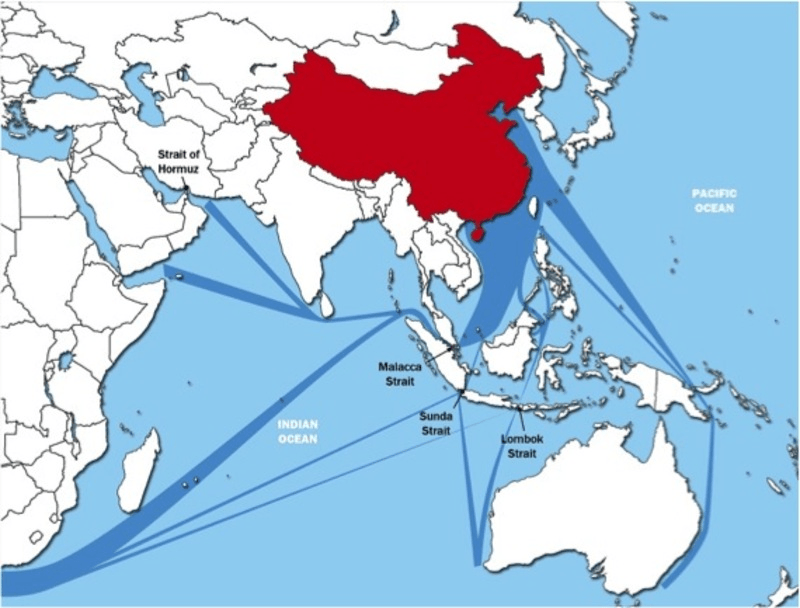
Image: CSBA: Shipping Lanes through the South China Sea.
The US has actually surrounded China with 400 military bases, bristling with strategic and tactical weaponry. It also has war-gamed out China’s key vulnerability: the chokepoint of the South China Sea. War in the South China Sea would disrupt $5.3 Trillion of China’s external trade and 77% of China’s oil imports[5]. In this scenario, the US does not have to win a shooting war with China in the South China Sea. The war just has to happen, and the disruption to trade could crash China’s economy. The map shows the shipping lanes that would be disrupted.
China’s first response to the US pivot and encirclement, especially in the South China Sea–its key chokepoint–was to build defensive military facilities along some of the islands, to deter US incursion and to raise the cost of interference. Its other response, much more ambitious, was the Belt & Road Initiative (BRI), which constitutes a long overland escape from the encirclement, similar to its “long march” during its encirclement by the fascist KMT. The BRI travels through SE Asia, then overland through Central Asia, to the Mediterranean, and then Europe and Africa. In particular:
+ CMEC (China-Myanmar Economic Corridor) travels through Rakhine State and exits to the Indian Ocean at Kyaukphyu port (bypassing the Strait of Malacca).
+ CPEC (China-Pakistan Economic Corridor) to Gwadar port transits directly to the Arabian Sea and the Persian Gulf.
+ Xinjiang is the key overland route for BRI to exit China to Central Asia, with Iran also a key node.
+ Djibouti at the horn of Africa is the entry node to Africa (the Sahel, and the South)
BRI as it does this, becomes the physical realization of Mackinder’s “heartland” in Eurasia—the pivot state connecting the “world island” into a single economic bloc, and raising China to the status of the key regional power, exactly what Brezinski and Wolfowitz, sought to prevent.
Image: Mercator Institute for China Studies: Belt and Road Initiative.
Mindful of this development, and aware of the rapidly ticking biological clock on US power, the US is currently rapidly escalating hostilities in the SCS, most recently with war games, U2 incursions, belligerent passages of aircraft carriers, guided missile destroyers, submarines; China’s response has been to launch “carrier killer” missiles into the region.
In December 2018, Rear Admiral Lou Yuan of the PLA Navy said, ‘What the United States fears the most is taking casualties,’ and suggested that sinking two US aircraft carriers would be sufficient to expel the US from the South and East China seas. ‘We’ll see how frightened America is.’
The authors say that using this concept of ‘offensive deterrence’ by conducting strikes that kill Americans or Australians would not have the deterrent effect the PRC seeks or expects ‘and the risks of escalation from such a deterrent effort are extremely high’.
So, they say, planners must take this into account both when seeking to deter China as well as when thinking through what actions it might take or how it might react to our actions.
In examining how China might be deterred from actions inimical to international goals and standards, the report contains various definitions of what deterrence actually is. One is that of strategist Thomas Schelling, described as the contemporary father of coercion theory: ‘To be coercive, violence has to be anticipated. And it has to be avoidable by accommodation. The power to hurt is bargaining power. To exploit it is diplomacy—vicious diplomacy, but diplomacy.’
Zhao Xijun of the PRC’s National Defense University defines ‘offensive deterrence’ in his book Coercive warfare: a comprehensive discussion on missile deterrence as ‘a military deterrence that mainly aims at attacking’ and writes that ‘the characteristic of offensive deterrence is to use “pre-emptive strike” to deter the other side’. Zhao also states that this concept is ‘“using war to stop war” by [using] small war to constrain large war’.
The authors compare the current situation to the way the US and the Soviet Union related to each other during the Cold War. Apart from contact at organisations such as the United Nations, the two sides had little interaction, little trade, little commerce and relatively little overlap in their geographical spheres of influence.
‘There was tension and conflict on the margins with clear escalatory potential, but the two sides managed to avoid direct or large-scale confrontations, albeit narrowly at times. That was in large part because the two sides developed a shared basic understanding of the world.’
Everyone in the military and the broader defence and security establishment knew something about the Soviets and their military. People studied what the Soviets thought, how they spoke and the actions that they took, down to the smallest details.
Each side developed a solid basis for understanding the signals the other side was sending, and typically sent clear signals of its own.
The authors say that that is not the case today.
‘The CCP’s understanding of the world, and thus its approach to it, is significantly different from Western views. It’s neither right nor wrong, just a different perspective, and one that isn’t common in Western liberal democracies; nor is it commonly taught in Western education systems, or indeed even in professional military education.’
They say that Australian and US partners and allies such as Japan, South Korea, Singapore and Taiwan have a historical appreciation and can help contribute to a better understanding of historical concepts. But, since 2001, the US and many of its partners have been focused on fighting terrorist groups and managing the conflicts in Iraq, Afghanistan and the broader Middle East.
Only during the latter part of the Trump administration did the US truly focus the whole of government on addressing the competition with China, bringing in Congress as well as the military, the State Department, the Committee on Foreign Investment in the United States and others.
While it takes years to build a deep and wide group of specialists in any field, the authors say, it stands out that the US Air Force has the same number of foreign area officer places for Chinese specialists as it does for Portuguese speakers.
They warn that if the US and its allies and partners hope to avoid conflict with China, they must build a deeper shared understanding of how the CCP and the PRC see the world. That will require sustained effort over several years and involve a deep partnership with partners and allies who have vital knowledge and expertise.
They also urge planners not to ‘mirror ourselves onto our analysis of PRC thinking and action’.
They say that: ‘With sustained effort, we can do better at understanding Chinese thought and concepts and the twists that CCP ideology gives them. In that way, we can maximise our opportunities to ensure that our strategic goals are met and our interests are protected.’